

VRF Systems Explained: Are They Right for a Luxury NYC Renovation?

VRF systems for luxury NYC renovations: how they work, heat pump vs heat recovery, cost, brands, and when mini-splits or mini-ducts are the better spec
VRF (Variable Refrigerant Flow) systems use one outdoor unit connected to multiple indoor units via refrigerant piping, with each zone independently controlled. The defining capability: heat recovery VRF can heat one room while simultaneously cooling another, transferring waste energy between zones rather than discarding it. Leading residential platforms are Mitsubishi City Multi and Daikin VRV. Installed cost for a luxury NYC townhouse runs $30,000 to $80,000+ depending on zone count and system type. VRF delivers 25-40% energy savings over conventional HVAC and is the standard specification for multi-floor townhouses, large co-ops, and high-end condos above 5,000 SF. For smaller projects (under 5,000 SF, fewer than 8 zones), ductless mini-splits or high-velocity mini-duct systems are more cost-effective.
VRF systems are the most sophisticated HVAC technology available for luxury residential renovation. Originally developed by Daikin in Japan in 1982 and widely adopted in Europe and Asia before reaching the U.S. market, VRF has become the standard for multi-zone climate control in buildings where conventional ductwork is impractical, zone count is high, and energy efficiency matters. In the NYC residential market, VRF is specified for multi-floor townhouses, large co-op renovations, and high-end condos where the building needs 10, 15, or 20+ independently controlled zones operating from a single outdoor unit. It is the system that can heat a south-facing living room in winter while simultaneously cooling a server closet or a sun-drenched bedroom on the same floor.
This guide covers how VRF works, the two system types (heat pump vs heat recovery), the leading brands, cost, advantages and disadvantages, NYC-specific considerations, and when VRF is the right specification versus a ductless mini-split system or a high-velocity mini-duct system.
What Is a VRF System?
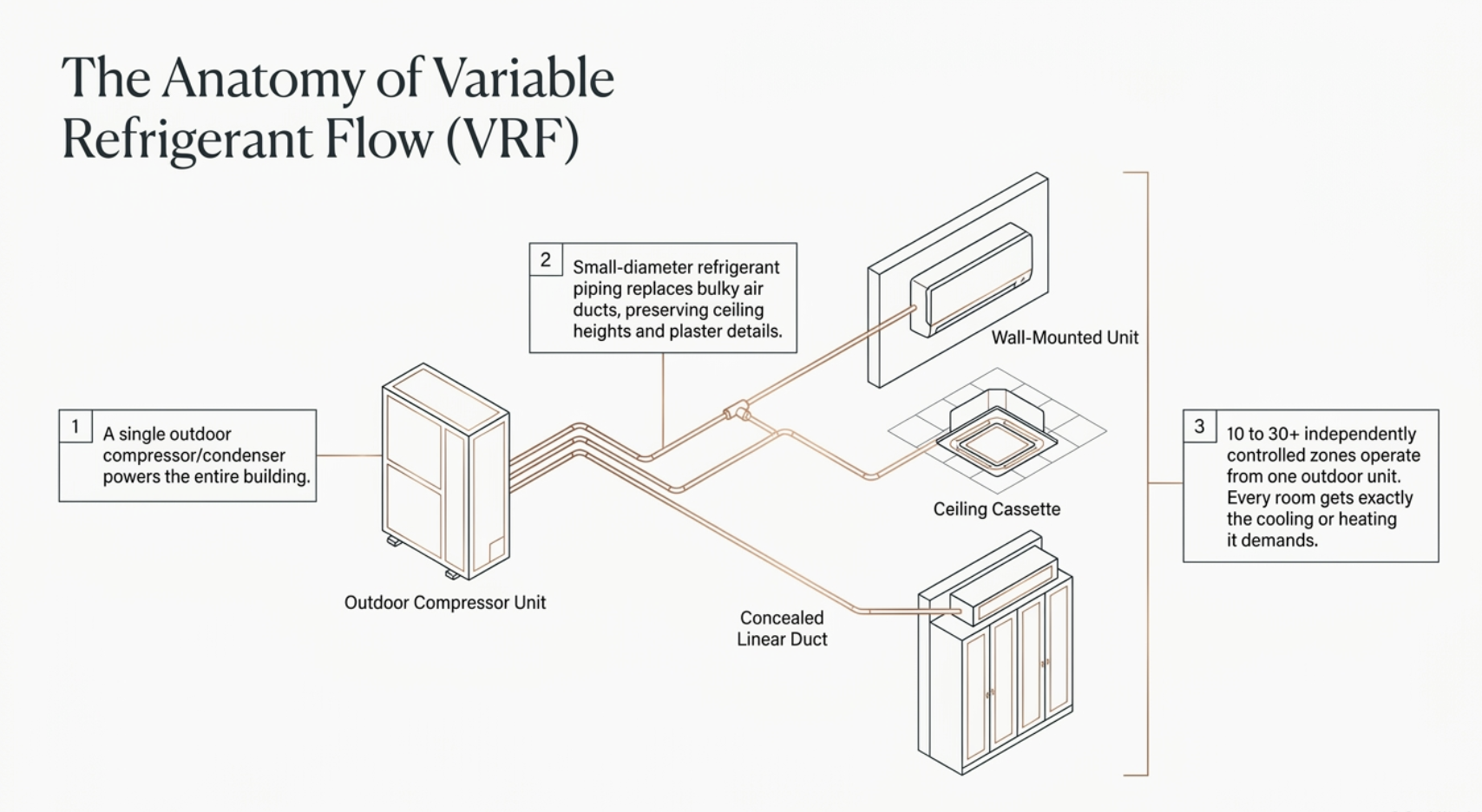
A VRF system (Variable Refrigerant Flow) is a central HVAC system that uses a single outdoor compressor/condenser unit connected to multiple indoor units through a network of small-diameter refrigerant piping. The system varies the flow of refrigerant to each indoor unit based on real-time demand, delivering precisely the amount of heating or cooling each zone needs at any given moment.
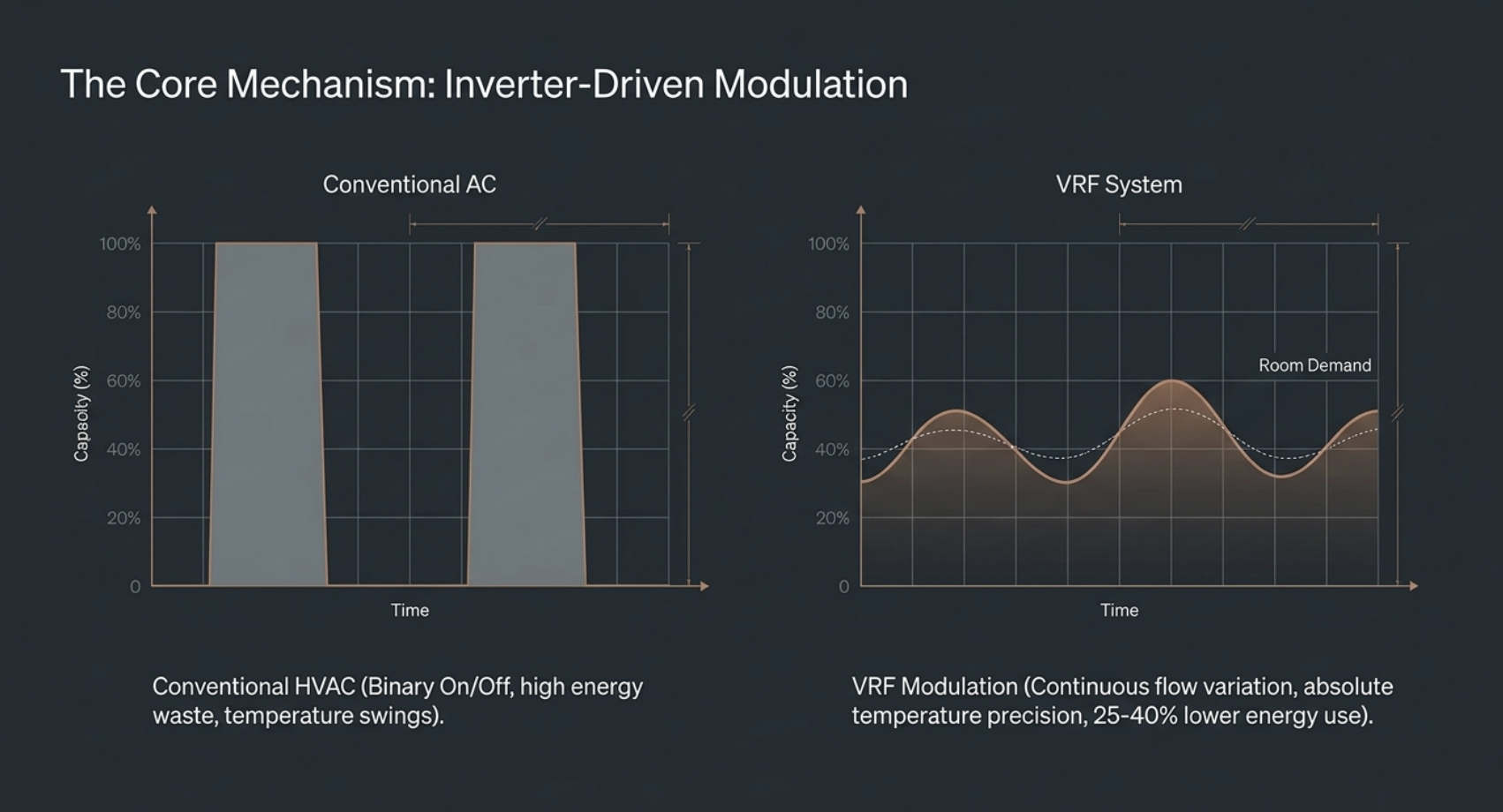
The term "variable refrigerant flow" describes the core mechanism. Unlike conventional systems that run at full capacity or off (cycling on and off to maintain temperature), VRF compressors use inverter-driven technology that modulates continuously. When a bedroom needs light cooling, the system sends a small amount of refrigerant. When a living room needs full heating, it sends more. Every zone gets exactly what it requires, and the compressor adjusts its output to match the total load across all zones simultaneously.
VRF vs VRV: VRV (Variable Refrigerant Volume) is Daikin's trademarked name for VRF technology. Daikin invented the category in 1982 and registered the VRV trademark. Mitsubishi Electric calls their version City Multi. LG calls theirs Multi V. Samsung uses DVM. All are VRF systems. The underlying engineering is the same: inverter-driven compressor, variable refrigerant flow per zone, networked controls. The differences are in component design, control platforms, and service ecosystems.
The indoor units come in the same form factors as mini-splits: wall-mounted, ceiling cassette (4-way or 1-way), floor-mounted, and concealed duct. A single VRF outdoor unit can support 30 or more indoor units depending on the platform and building load, which is far more than a multi-zone mini-split system can handle (typically capped at 5-8 heads per outdoor unit).
What Is the Difference Between VRF Heat Pump and Heat Recovery?
This is the most important specification decision in a VRF project.
Heat Pump VRF
A heat pump VRF system operates in one mode at a time across all connected zones: either all zones are heating, or all zones are cooling. The system switches between modes based on the building's overall demand. The refrigerant circuit uses two pipes (liquid and suction) connecting the outdoor unit to all indoor units.
Heat pump VRF costs 15-25% less than heat recovery because the refrigerant circuit is simpler, there are no branch controllers (the "traffic cops" that route refrigerant in heat recovery systems), and installation is more straightforward. It is the right choice when all zones in the building have similar thermal loads and the need for simultaneous heating and cooling is minimal.
Heat Recovery VRF
A heat recovery VRF system can heat some zones while simultaneously cooling others, transferring waste heat from the cooling zones to the heating zones. This is the capability that makes VRF unique among residential HVAC technologies. A south-facing room overheating from afternoon sun can reject its excess heat, and that energy is redirected to a north-facing room that needs warming. Instead of discarding the heat outside (as a conventional system does), the heat recovery system recycles it internally.
The refrigerant circuit is more complex: either a three-pipe system or a two-pipe system with branch controllers (called BC boxes by Mitsubishi, BS boxes by Daikin) at each zone junction. These controllers act as refrigerant routing switches, directing flow to each indoor unit in the mode it needs.
Heat recovery VRF costs 20-35% more than heat pump VRF but delivers 30-40% energy savings over conventional HVAC (versus 25-35% for heat pump VRF). The higher capital cost pays back through lower operating cost, particularly in buildings with diverse thermal loads.
| Feature | Heat Pump VRF | Heat Recovery VRF |
|---|---|---|
| Simultaneous heating and cooling | No (one mode at a time) | Yes |
| Piping configuration | 2-pipe | 3-pipe or 2-pipe with branch controllers |
| Energy savings vs conventional | 25-35% | 30-40% |
| Installation cost | Lower (15-25% less) | Higher (20-35% more) |
| System complexity | Moderate | High |
| Best for | Uniform load buildings | Mixed-load buildings, large residences |
How Much Does a VRF System Cost?
VRF systems carry the highest capital cost of any residential HVAC technology. The investment reflects the system's sophistication, the specialized installation expertise required, and the engineering design work that precedes installation. For luxury residential projects in NYC:
| Configuration | NYC Installed Range |
|---|---|
| 8-10 zone heat pump VRF (large townhouse floor) | $30,000-$50,000 |
| 8-10 zone heat recovery VRF | $40,000-$65,000 |
| 15-20 zone heat pump VRF (full townhouse) | $60,000-$100,000 |
| 15-20 zone heat recovery VRF (full townhouse) | $80,000-$130,000 |
| 25+ zone heat recovery VRF (large residence) | $120,000-$200,000+ |
These ranges include equipment, refrigerant piping, branch controllers (for heat recovery), indoor units, controls, electrical work, DOB permits, and commissioning. They do not include structural modifications for condenser placement, crane/rigging costs for rooftop installation, or LPC review fees.
Cost per zone is a useful planning metric: $3,000-$6,000 per zone for heat pump, $4,000-$8,000 per zone for heat recovery. The per-zone cost decreases as zone count increases because the outdoor unit and piping infrastructure represent a larger share of fixed cost that is distributed across more zones.
The R-410A to R-32/R-454B refrigerant transition currently underway adds 15-30% to equipment cost for 2025-2026 production units. This premium will normalize as manufacturers complete the transition, but projects specifying VRF in 2026 should budget for the surcharge.
NYSERDA Clean Heat rebates and federal tax credits for qualifying heat pump systems can offset $3,000-$10,000+ of the installed cost depending on system efficiency and configuration.
VRF System Advantages for Luxury Residential
Simultaneous Heating and Cooling
The defining capability. Heat recovery VRF heats the north-facing bedroom while cooling the south-facing living room at the same time, recycling energy between zones instead of wasting it. No other residential HVAC technology can do this. In a multi-floor NYC townhouse where each floor has different sun exposure and different thermal loads, this capability eliminates the compromise of choosing one mode for the entire building.
Precise Per-Zone Temperature Control
Every indoor unit operates independently with its own thermostat and its own modulating refrigerant flow. The master bedroom holds 68°F while the home office holds 72°F while the wine storage holds 55°F. The system adjusts continuously based on real-time demand in each zone, not on a schedule or a cycle.
Energy Efficiency
VRF delivers 25-40% energy savings over conventional HVAC because the inverter-driven compressor modulates to match the exact load rather than cycling on and off at full capacity. The heat recovery function adds further savings by recycling energy between zones. For NYC buildings subject to Local Law 97 carbon emissions limits, VRF's efficiency advantage can reduce or eliminate penalty exposure.
Compact Outdoor Footprint
One VRF outdoor unit serves 10-30+ indoor zones. A 20-zone conventional system would require multiple outdoor condensers spread across the roof or yard. VRF consolidates to one unit (or two for redundancy), reducing the rooftop or yard footprint and simplifying LPC review for condenser placement in historic districts.
Quiet Operation
Modern VRF outdoor units operate at 50-58 dB, comparable to a normal conversation. Indoor units operate at 19-32 dB depending on fan speed. NYC noise ordinances limit outdoor equipment to 42 dB at the property line during nighttime hours. VRF outdoor units meet this threshold at typical installation distances.
No Ductwork Required
Like mini-splits, VRF indoor units can be wall-mounted, ceiling-recessed, or concealed with short duct runs. The system delivers conditioned air without the large trunk lines and branch ducts that conventional central air requires. This preserves ceiling heights, crown moldings, and plaster details in pre-war buildings and brownstones.
What Are the Disadvantages of VRF Systems?
High Capital Cost
VRF is the most expensive residential HVAC option. A 15-zone heat recovery system for a townhouse ($80,000-$130,000) costs 2-3x what a comparable multi-zone mini-split installation would cost. The energy savings and performance advantages are real, but the upfront investment is significant and the payback period is long (8-15 years depending on the building's load profile and energy costs).
Proprietary Ecosystem
VRF is brand-locked. Mitsubishi City Multi outdoor units only work with Mitsubishi indoor units and Mitsubishi branch controllers. Daikin VRV components do not mix with LG Multi V components. Once a brand is specified, the building is committed to that manufacturer's ecosystem for the life of the system. Parts, service, and future expansion all come from one source.
Specialized Service Requirements
VRF systems require technicians trained and certified on the specific platform installed. A general HVAC technician cannot diagnose or service VRF controls, branch controllers, or refrigerant management systems without manufacturer-specific training. In NYC, the pool of qualified VRF technicians is growing but still smaller than the pool of technicians who can service conventional systems or mini-splits. Service calls cost more, and response times can be longer.
Refrigerant Charge and ASHRAE 15 Compliance
VRF systems carry large total refrigerant charges because one outdoor unit serves many zones through extensive piping networks. ASHRAE Standard 15 limits the refrigerant charge per occupied space based on room volume and refrigerant toxicity classification. In small rooms (home offices, bedrooms, closets), the allowable charge may constrain the number of indoor units or require additional ventilation. The design engineer must verify ASHRAE 15 compliance for every zone during system design.
Heating Capacity Degradation in Extreme Cold
All air-source heat pump technology, including VRF, loses heating capacity as outdoor temperatures drop. At 0°F, a VRF system may deliver only 70-80% of its rated heating capacity. For NYC's climate (where temperatures occasionally drop below 10°F), this is manageable with proper sizing. For supplemental heating on the coldest days, many VRF installations include electric resistance backup or integrate with an existing boiler.
Which Brands Lead the NYC Residential VRF Market?
Mitsubishi City Multi
Mitsubishi Electric's City Multi platform has the largest installed base in NYC commercial and high-end residential. The system uses R-410A (transitioning to R-454B in 2026 production). Mitsubishi has the deepest trained-technician network in the NYC metro area and the most readily available parts inventory. City Multi is the default specification for many NYC mechanical engineers.
Daikin VRV
Daikin's VRV platform (currently VRV 5) is the closest competitor. Daikin invented VRF technology in 1982 and has the longest track record globally. The VRV 5 uses R-32 refrigerant (a more efficient A2L refrigerant with lower GWP than R-410A). Daikin's Building Management System (BMS) integration (via the Intelligent Touch Manager) is considered the most advanced in the category, making it the preferred specification for buildings with sophisticated automation needs.
LG Multi V and Samsung DVM
LG and Samsung offer competitive VRF platforms at lower price points than Mitsubishi and Daikin. Both are established in the NYC commercial market. For residential projects where budget is a primary constraint, LG Multi V offers strong performance with lower equipment cost. Samsung DVM is less common in NYC residential but growing.
| Brand | Platform | Refrigerant (2026) | NYC Service Network | Best For |
|---|---|---|---|---|
| Mitsubishi | City Multi | R-454B (transitioning) | Largest | Broadest support, default spec |
| Daikin | VRV 5 | R-32 | Strong | BMS integration, automation |
| LG | Multi V | R-32 | Growing | Budget-conscious commercial |
| Samsung | DVM | R-32 | Limited | Value specification |
NYC-Specific Considerations
DOB Permits and Mechanical Code
All VRF installations in NYC require Department of Buildings permits. The work must be performed by a licensed HVAC contractor, and the system must comply with the NYC Mechanical Code. VRF installations are more complex to permit than mini-splits because the refrigerant piping network, branch controllers, and total system charge all require engineering documentation. For a broader look at code compliance, see Navigating NYC Building Codes.
Landmarks Preservation Commission
In historic districts, outdoor condenser placement requires LPC review. VRF has an advantage here: one outdoor unit serves 10-30+ zones, which means fewer condensers and fewer exterior penetrations than a multi-head mini-split installation that requires a separate condenser for every 3-5 zones.
Local Law 97 Compliance
NYC's carbon emissions law (LL97) imposes penalties on buildings exceeding emissions thresholds starting in 2024. VRF's 25-40% energy savings over conventional HVAC can reduce or eliminate penalty exposure for covered buildings. For properties near the LL97 threshold, the VRF efficiency advantage may justify the higher capital cost through avoided penalties.
Co-op and Condo Board Approval
Board approval is required for VRF installations in multi-unit buildings. The mechanical plans, noise studies, condenser location, and any structural modifications for equipment mounting all require board review. Allow 4-8 weeks for the alteration agreement process.
Electrical Infrastructure
VRF outdoor units require dedicated high-amperage circuits (40-60+ amps at 208-230V depending on system size). Pre-war buildings with limited electrical capacity may need panel upgrades ($2,000-$5,000) or service upgrades ($5,000-$15,000) to support the system. Verify electrical capacity before committing to a VRF specification.
Is VRF Worth It for a Residential Renovation?
Specify VRF if the building is large (5,000+ SF), the zone count is high (8+ independently controlled zones), the building has diverse thermal loads (simultaneous heating and cooling needed), energy efficiency and LL97 compliance matter, and the budget supports the capital investment. Multi-floor townhouses, large co-ops, and high-end condos with 10+ rooms are the sweet spot for residential VRF.
Specify a ductless mini-split system instead if the zone count is low (under 8), the budget is constrained (mini-splits cost roughly half what VRF costs for comparable zone count), or the project does not need simultaneous heating and cooling. Mini-splits install faster, cost less, and perform well for most NYC apartments and smaller townhouse floors.
Specify a high-velocity mini-duct system instead if invisible HVAC is the top priority (no visible indoor units), superior dehumidification matters, or the project is already in renovation with walls open. Mini-duct systems deliver the most discreet indoor distribution and the best moisture removal.
For how VRF compares to the two most common residential alternatives, see our guides to ductless mini-split systems and high-velocity mini-duct systems for NYC brownstones.
Frequently Asked Questions
What is a VRF system?
VRF (Variable Refrigerant Flow) is a central HVAC system that uses one outdoor unit connected to multiple indoor units via refrigerant piping. Each zone is independently controlled. The compressor modulates continuously to match real-time demand, delivering 25-40% energy savings over conventional systems. VRV is Daikin's trademark for the same technology.
How much does a VRF system cost for a residential renovation?
In NYC, a 10-zone heat pump VRF system runs $30,000-$50,000 installed. A 10-zone heat recovery system runs $40,000-$65,000. A full 15-20 zone townhouse installation runs $60,000-$130,000+ depending on system type and complexity. NYSERDA rebates can offset $3,000-$10,000+.
What are the disadvantages of VRF systems?
High capital cost (2-3x more than mini-splits for comparable zone count), proprietary brand-locked ecosystem, specialized service requirements (certified technicians only), large refrigerant charges requiring ASHRAE 15 compliance verification, and heating capacity degradation in extreme cold.
What is the difference between VRF heat pump and heat recovery?
Heat pump VRF operates in one mode at a time (all zones heating or all cooling). Heat recovery VRF heats some zones while simultaneously cooling others, recycling waste energy between zones. Heat recovery costs 20-35% more but delivers greater energy savings in buildings with diverse thermal loads.
How long does a VRF system last?
Outdoor compressor units typically last 15-20 years. Indoor units can last 20+ years. Branch controllers and controls last 15-20 years. Regular maintenance (annual coil cleaning, refrigerant charge verification, filter replacement) is essential for reaching full lifespan. All major brands offer 10-12 year compressor warranties when registered.
Is VRF overkill for a residential project?
For a small apartment or a single-floor renovation with 3-5 zones, yes. Mini-splits deliver equivalent comfort at lower cost for smaller projects. VRF becomes the right specification when the zone count exceeds 8, the building is multi-floor, or simultaneous heating and cooling is needed. The threshold is roughly 5,000 SF and 8+ zones.
VRF systems represent the highest tier of residential HVAC technology: the most zones, the most precise control, the most energy-efficient operation, and the highest cost. For multi-floor NYC townhouses, large co-ops, and luxury condos where the building demands 10-20+ independently controlled zones and energy efficiency matters, VRF is the specification that delivers what no other system can. For smaller projects, ductless mini-splits and mini-duct systems are more practical and more cost-effective.
If you are planning a luxury renovation that includes HVAC and need guidance on whether VRF, mini-split, or mini-duct is the right specification for your building, start a conversation with us. CooperBuild is a design build construction company whose general contracting team coordinates HVAC alongside electrical, plumbing, and millwork so every system is planned before the walls close. See completed renovations in our project portfolio.
- Category: Expert Advice / HVAC
- Topic: VRF Systems for Luxury NYC Renovations
- Author: CooperBuild Team
- Published: October 2026
- Sources:
- • Mitsubishi Electric City Multi
- • Daikin VRV
- • NYSERDA Clean Heat Program
- • ASHRAE Standards 15 and 34
- • NYC Mechanical Code
- • NYC Local Law 97
Planning HVAC for a Luxury Renovation?
CooperBuild coordinates HVAC design and installation for custom residential projects in NYC, the Hamptons, and South Florida. From VRF specification to mini-split and mini-duct alternatives, DOB permits, and LPC filings, we plan the mechanical system before the walls close.
Start a ConversationSubscribe to Our Newsletter
Get the latest insights, trends, and news from the construction industry delivered straight to your inbox.
We respect your privacy. Unsubscribe at any time.